Salaar: Part 1 - Ceasefire Review: Loyalty in Gunmetal Grey
Salaar: Part 1 - Ceasefire is Prashanth Neel's brutal Telugu power-struggle epic starring Prabhas, strongest in its action and weakest in its crowded politics.
★★★½☆ 3.5/5
Yes, with reservations. Fans of large-scale Indian action will get the thunderous set pieces they came for, if they can tolerate a murky plot and nearly three hours.
Is Salaar: Part 1 - Ceasefire worth watching?
Yes, for viewers who want big-screen Indian action at its most ferocious, though Salaar: Part 1 - Ceasefire is more satisfying as a sequence of explosions than as a story. Prashanth Neel builds a brooding hero, a blood-soaked kingdom and a friendship worth caring about, and the fights land with real weight. The reservation is everything in between: a tangle of clans, councils and backstory that the film explains at length without making it vivid, all stretched across 175 minutes that end on a deliberate cliffhanger.
What is Salaar: Part 1 - Ceasefire about?
Salaar: Part 1 - Ceasefire turns on two men. Deva (Prabhas) is a tribesman of few words, and Varadha (Prithviraj Sukumaran) is the prince of Khansaar, a fictional city-state run like a fortified crime empire. The two were bound together in childhood, and when ministers and relatives of Varadha’s father plot a coup, the prince turns to Deva to help him become Khansaar’s undisputed ruler.
The film does not start there. Its opening stretch finds Deva living a deliberately small life far from Khansaar with his watchful mother (Easwari Rao), until the arrival of a young woman played by Shruti Haasan draws dangerous attention to him. Only gradually does the film pull back to reveal the kingdom he came from.
Neel wrote and directed the film, his first with Prabhas. It is an Indian production made in Telugu and released in December 2023, and it runs just under three hours, the first of a planned two-part story.
Neel’s world is grim by design
Anyone who has seen Neel’s K.G.F. films will recognise the house style immediately. The palette is drained almost to monochrome, with smoky interiors, ash-coloured skies and faces lit by fire, and the effect is of a world where daylight has been rationed. It gives Khansaar a heavy, mythic weight, and it suits a story about inherited violence. The drawback is that it also flattens the film: after a couple of hours, one grey stone hall starts to look like the next.
The action is where the style pays off. Neel stages his set pieces as slow, deliberate build-ups toward release, with long stretches in which Deva refuses to fight before he finally does. When those moments arrive they are genuinely thunderous, choreographed for maximum impact and cut to the rhythm of a pounding score. It is maximalist mass cinema, and on its own terms it is often very effective.
Prabhas and Prithviraj give the epic a heart
The film’s best idea is its central friendship. Prabhas plays Deva as a near-silent force, a man whose restraint is itself a kind of threat, and his screen presence carries scenes that are mostly about waiting. It is a physical, minimal performance that fits Neel’s approach, even if it leaves the character more icon than person.
Prithviraj Sukumaran has the more interesting role. Varadha is proud, wounded and caught inside a family that treats power as a blood sport, and Prithviraj gives him an anxious intelligence that makes the palace intrigue feel personal. Their scenes together, and the loyalty Deva owes his friend, are what keep the film moving when the plotting slows. Jagapati Babu and Sriya Reddy add welcome menace among Khansaar’s ruling families.
Too many clans, not enough clarity
The problem is how much Salaar wants to explain. The second half leans heavily on exposition about Khansaar’s tribes, factions and the ceasefire of the title, and the sheer number of names and alliances makes it hard to follow who wants what. Shruti Haasan’s character, central to the opening, is largely sidelined once the story moves on. Because this is only Part 1, several threads are left open, and the film’s sense of shape suffers for it.
Who should watch Salaar: Part 1 - Ceasefire?
This is for viewers who enjoy large-scale Indian action cinema and are happy to trade tight storytelling for spectacle, star power and mood. Prabhas’s fans will find a showcase built entirely around his presence. Be ready for a long sit and for bloody, frequently brutal violence, including stabbings and mass combat; it is not family viewing.
If it works for you, these are natural companions:
- K.G.F: Chapter 1, Neel’s earlier gangster saga, which established the same smoky, operatic style.
- K.G.F: Chapter 2, a louder continuation of that story, for anyone who wants more of Neel’s scale.
- Baahubali: The Beginning, another Prabhas epic of kingdoms and succession, told with more colour and clarity.
The verdict
Salaar: Part 1 - Ceasefire is a heavy, often exhilarating action spectacle anchored by a strong central friendship and two committed lead performances. Its murky look and overcrowded politics wear down the long running time, and it asks a lot of patience for a story that is only half told, but the set pieces deliver what the genre promises.
Rating: 3.5/5
Availability is a catalogue snapshot and can change. Confirm with the provider in your region.
Where to watch Salaar: Part 1 - Ceasefire
Streaming: Netflix
By region: Netflix in the United States; Netflix in the United Kingdom; Netflix, Disney+ in Indonesia; Netflix, Vi Movies & TV in India
Full scores and availability on the movie page.
If you liked Salaar: Part 1 - Ceasefire
Ranked by genre overlap and Celluloid Score. More movies like Salaar: Part 1 - Ceasefire →
 Featured
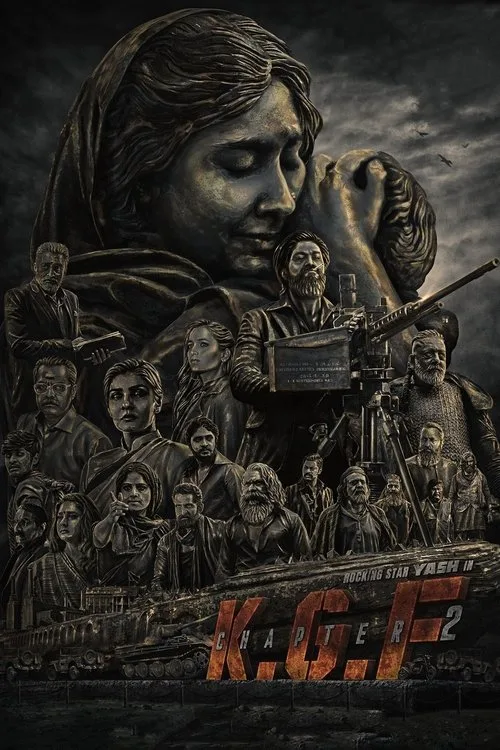
K.G.F: Chapter 2
Action, Thriller · 2h 48m
 Featured
K.G.F: Chapter 1
Action, Thriller · 2h 36m
 HKIFF 1989
The Killer
Action, Crime · 1h 50m
 FeaturedMAMI 2012
Gangs of Wasseypur
Crime, Drama · 2h 40m
Where can I watch Salaar: Part 1 - Ceasefire?
Streaming: Netflix. Regional notes: Netflix in the United States; Netflix in the United Kingdom; Netflix, Disney+ in Indonesia; Netflix, Vi Movies & TV in India.